
Introduction:
Commercial real estate marketing in the United States is entering a new phase in 2026, where artificial intelligence is no longer optional but essential for firms that want consistent deal flow and measurable ROI. Brokers, property managers, and commercial real estate agencies are using AI-driven marketing strategies to identify qualified investors, automate property promotion, and shorten sales cycles in competitive markets. Traditional outreach methods alone can no longer keep up with rising acquisition costs, fragmented lead sources, and data-heavy decision-making. A structured AI commercial real estate marketing strategy allows CRE professionals to combine predictive analytics, automated content creation, intelligent CRM systems, and targeted advertising into a single performance-driven process designed to generate high-value commercial property leads.
This guide explains how commercial real estate professionals in the USA can implement practical AI marketing systems that convert interest into signed leases and closed deals. Instead of theory, you will learn real-world strategies, including AI-powered lead generation, listing optimization, virtual property experiences, and performance tracking frameworks used by successful CRE teams. Whether you manage office buildings, retail spaces, or industrial properties, these proven AI marketing methods will help you attract serious buyers and tenants while building a scalable commercial real estate growth strategy for 2026 and beyond.
Why AI is Transforming Commercial Real Estate in the USA
Artificial intelligence is changing commercial real estate marketing in the United States. Today, CRE brokers use AI to improve marketing results.
AI helps professionals analyze market data faster. As a result, agencies can find serious investors and tenants. Property listings also become easier to optimize.
AI tools show clear insights into US market trends. For example, agencies can track rental demand easily. They can also monitor pricing changes. Therefore, teams focus on better opportunities.
Automation saves time on routine tasks. In addition, AI handles CRM updates and follow-ups. Listing content can be created faster.
Because of automation, professionals focus on closing deals. Marketing becomes faster and more efficient.
In 2026, AI-driven commercial real estate marketing will become a strong advantage. Finally, companies using AI will grow faster.
AI Commercial Real Estate Marketing Strategy Core Components
An effective AI-powered approach to property promotion depends on clear planning and reliable data. Modern platforms help agents identify serious buyers, track behavior, and improve campaign performance. Instead of guessing what works, professionals can rely on analytics to refine targeting and messaging. This method saves time and reduces marketing costs while improving lead quality. When applied correctly, AI tools make campaigns more consistent and easier to scale across different property listings.
AI-Powered Lead Generation
AI platforms can automatically identify potential investors or tenants by analyzing behavioral data, search patterns, and property interest. Integrating AI with CRM tools like HubSpot or Salesforce allows CRE professionals to score and prioritize leads, ensuring the most promising contacts receive immediate attention.
Listing Optimisation with AI
AI can create property descriptions, social media posts, and email content that target specific investor personas. It can also generate visual property content, such as virtual tours and 3D staging, which are increasingly important for US commercial markets.
Predictive Analytics for Investment and Pricing
By analyzing market trends, past transaction data, and regional metrics, AI predicts rental rates, vacancy risks, and ROI potential. Agencies can price commercial properties accurately and attract serious investors faster.
Automated CRM and Follow-Up Systems
AI-driven CRMs track every lead interaction, automate follow-ups, and nurture relationships through personalized communication. This ensures leads are continuously engaged until they convert into tenants, buyers, or investors.
Real-Time Reporting and KPI Tracking
AI dashboards offer instant visibility into campaign performance, lead conversion rates, and ROI, enabling agencies to refine their marketing strategies and reallocate resources for optimal results.
Practical Use Cases of AI in Commercial Real Estate Marketing
Property Search and Smart Discovery
AI algorithms analyze buyer behavior and market data to recommend commercial properties that meet the criteria of investors or tenants. This speeds up decision-making and increases deal closure rates.
Virtual Tours and 3D Visualisation
Platforms like Matterport and BrainBox AI create immersive property experiences. For example, investors and tenants can explore properties online. This saves time and increases engagement.
In addition, virtual tours allow agents to showcase multiple properties quickly. As a result, decision-making becomes faster for potential buyers and tenants.
Moreover, AI-powered 3D visualization tools provide detailed insights into layouts and spaces. Therefore, agencies can highlight key features that attract high-value clients.
By using virtual tours and 3D visualization, commercial real estate marketing becomes more interactive, efficient, and effective.
AI Content Creation for Listings and Marketing
AI can generate high-quality property descriptions, ad copy, and email campaigns personalized to target audiences. This increases click-through rates and conversions.
Pricing, Valuation, and Investment Analysis
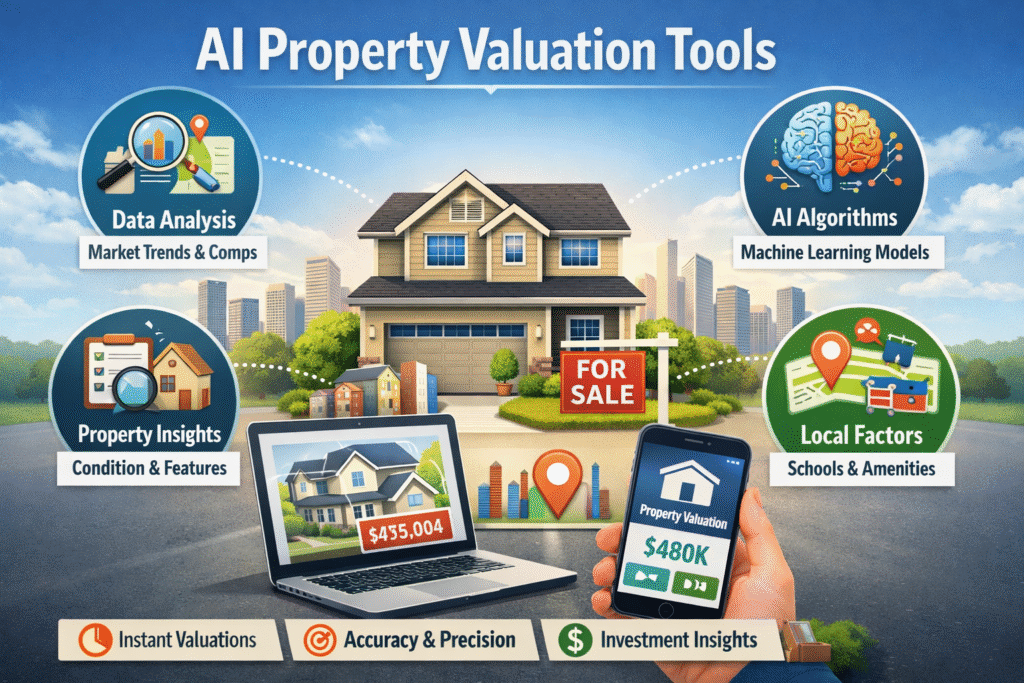
AI tools such as HouseCanary, Cherre, and IntellCRE provide predictive pricing models and property valuations. This ensures competitive pricing for commercial listings in US markets.
Tenant Management and Operations
AI-driven platforms can automate lease management, tenant communication, and property maintenance, improving efficiency and tenant satisfaction.
Integrating Your Published Article
For those seeking more foundational knowledge about commercial real estate, check out our guide:
Commercial Real Estate Explained: A Complete 2026 Guide
Commercial real estate (CRE) involves properties used for business purposes. For instance, office buildings, shopping centers, and warehouses fall under CRE. In addition, industrial spaces, hotels, and multi-family complexes are included.
Investing in CRE requires careful research. Therefore, brokers and property managers rely on market data to make smart decisions. Also, AI tools help automate research, forecast trends, and highlight high-value opportunities.
As a result, agencies can attract qualified leads and close deals faster. Moreover, AI improves marketing campaigns by optimizing property listings and personalizing outreach. Finally, CRE professionals who adopt AI gain a competitive edge in the United States market in 2026.
Emerging AI Trends for CRE in 2026
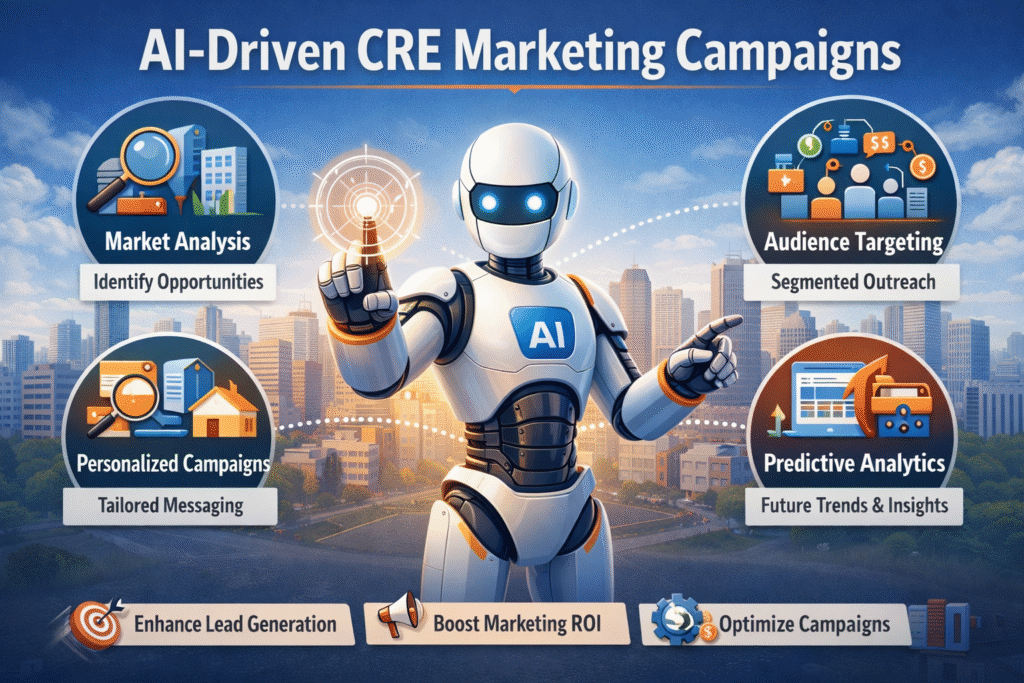
AI-First Search & Predictive Marketing
Voice search and AI-powered property recommendation systems allow investors and tenants to find the right commercial properties faster.
Generative AI for Personalised Campaigns
From email marketing to social media advertising, AI can create tailored campaigns that resonate with specific US investor segments.
Enterprise-Level AI Platforms
Tools like JLL Falcon, Prism, and Azara offer full CRE lifecycle solutions, from property analysis to marketing and tenant management.
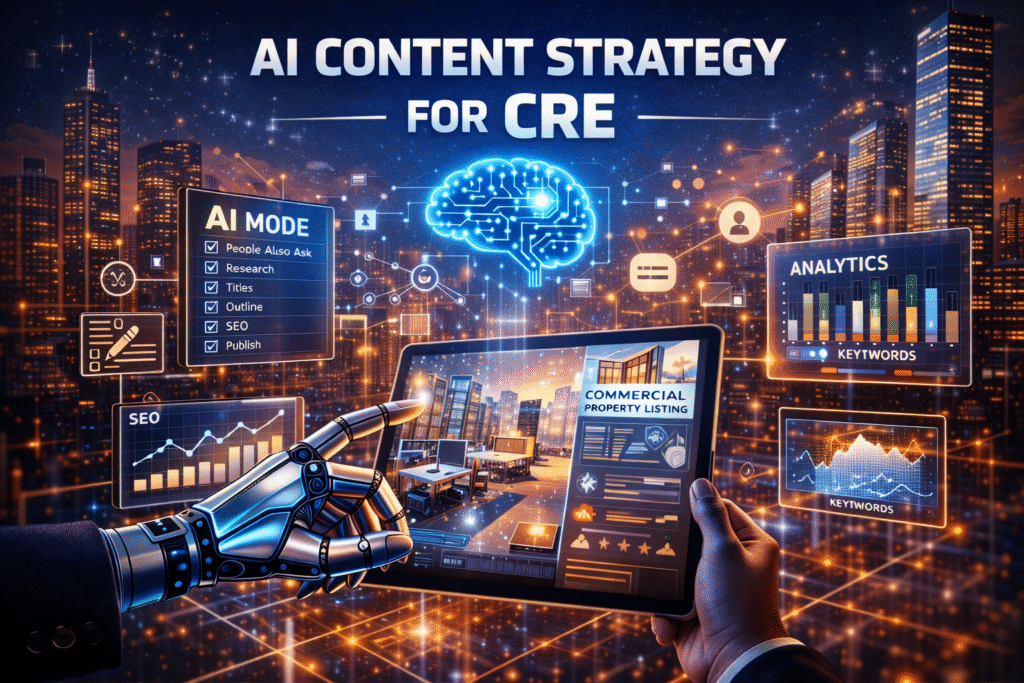
Step-by-Step AI CRE Marketing Roadmap
Market Research & Targeting: Identify high-value US properties and investor segments
Content Creation & Listing Optimisation: Generate AI-driven property content and virtual tours
Lead Capture & CRM Integration: Track leads, automate follow-ups, and segment prospects
Performance Monitoring & KPIs: Track lead-to-deal conversion, engagement, and ROI
Continuous Optimisation & Scaling: Test new AI tools, channels, and campaigns to maximise results
Conclusion:
In 2026, AI is no longer optional for commercial real estate marketing. Instead, it is essential for generating leads, closing deals, and maximizing ROI in the competitive US market. By leveraging AI-driven lead generation, predictive analytics, virtual tours, content automation, and CRM systems, CRE professionals can stay ahead of competitors.
Furthermore, an effective AI marketing strategy allows agencies, brokers, and property managers to scale efficiently. It also helps personalize campaigns and make data-driven decisions. From property search and valuation to marketing and tenant management, AI provides actionable insights and automation. As a result, interest converts into real deals faster than traditional methods.
Additionally, starting today can put your agency in a position to boost conversions, reduce operational inefficiencies, and grow your commercial property business. Ultimately, the next tenant, investor, or buyer could be just one AI-powered campaign away.
FAQs
Q1: What is AI commercial real estate marketing?
AI commercial real estate marketing uses artificial intelligence to automate property promotion, generate leads, and analyze market trends for better decision-making.
Q2: How does AI improve lead generation for CRE?
AI identifies high-potential investors or tenants, scores leads based on behavior, and automates follow-ups to increase conversion rates.
Q3: Can AI help with property valuation and pricing?
Answer: Yes, AI leverages historical data, market trends, and regional insights to provide accurate commercial property valuations. Furthermore, it helps set competitive pricing, forecast potential ROI, and identify opportunities for higher returns. As a result, CRE professionals can make informed decisions and reduce financial risks when marketing or selling properties.
Q4: Which AI tools are best for commercial real estate marketing?
Tools like ChatGPT, HubSpot CRM, Salesforce AI, Matterport, and predictive analytics platforms like HouseCanary or IntellCRE are widely used.
Q5: How can CRE agencies implement AI in marketing?
Answer: CRE agencies can start by integrating AI with their CRM systems. In addition, they should automate lead capture and generate high-quality content for property listings and ads. Moreover, using AI-powered virtual tours helps engage prospects more effectively. Finally, tracking KPIs allows agencies to continuously optimise their campaigns and maximise ROI.
Q6: Is AI suitable for all commercial property types?
Yes, AI works for office, retail, industrial, and mixed-use properties by analysing data, targeting tenants, and optimising marketing campaigns.
Q7: What is the ROI of using AI in commercial real estate marketing?
Agencies that adopt AI see faster lead conversion, reduced operational costs, better investor targeting, and measurable revenue growth.
Call to Action:
Start today by exploring the latest AI tools and strategies for commercial real estate marketing in the USA. By doing so, you can identify new leads, streamline your campaigns, and close deals faster. Furthermore, implementing this roadmap allows your agency to stay ahead of competitors and maximize ROI. As a result, your team will gain measurable growth and a stronger market presence throughout 2026. Ultimately, leveraging AI effectively is the key to scaling your commercial property business with confidence.
